
Florida Amendment 3 Passed: What the Bigger Homestead Exemption Means for You
Hey everyone!
Florida homeowners just got one of the biggest property tax breaks in the state's history.
Amendment 3 passed last night with about 62% of the vote, clearing the 60% it needed. For a lot of families, that means real money back in the monthly budget, starting with the 2027 tax year.
I've been getting texts since the results came in, so here's the practical breakdown for homeowners, investors, and the agents who work with them: what changed, when it kicks in, what it can look like on your escrow line, and the one detail most people are going to miss.

What actually changed
Here's the short version, straight from the amendment's ballot summary:
→ The homestead exemption for non-school property taxes goes to $150K in 2027, then $250K in 2028. Today it's effectively $50K for non-school taxes (two $25K exemptions). After 2028 it adjusts for inflation.
→ It applies to non-school property taxes. School taxes stay in place. The existing $25K exemption still applies to school taxes.
→ Non-homestead properties (rentals, second homes, commercial) get a lower cap on yearly assessment increases: 5% instead of 10%, starting January 1, 2027. Like the old cap, it doesn't apply to school district taxes.
→ New residents wait. Anyone who isn't a Florida resident on December 31, 2026 gets the existing exemption when they qualify for homestead, and the bigger exemption starts with their fifth year of exemption (the amendment says "to the extent permitted by the U.S. Constitution").
→ Local governments get tighter limits on how property tax revenue gets spent: public safety, education and schools, infrastructure, natural resources, bond debt, employee retirement, and operations.
→ Counties and cities can go further. The Legislature has to set up a uniform way for counties and municipalities to raise the homestead exemption for their own levies, up to full assessed value.
The amendment takes effect January 1, 2027.
That 5-year line is the one most people are going to miss. More on that below.
The timeline, year by year
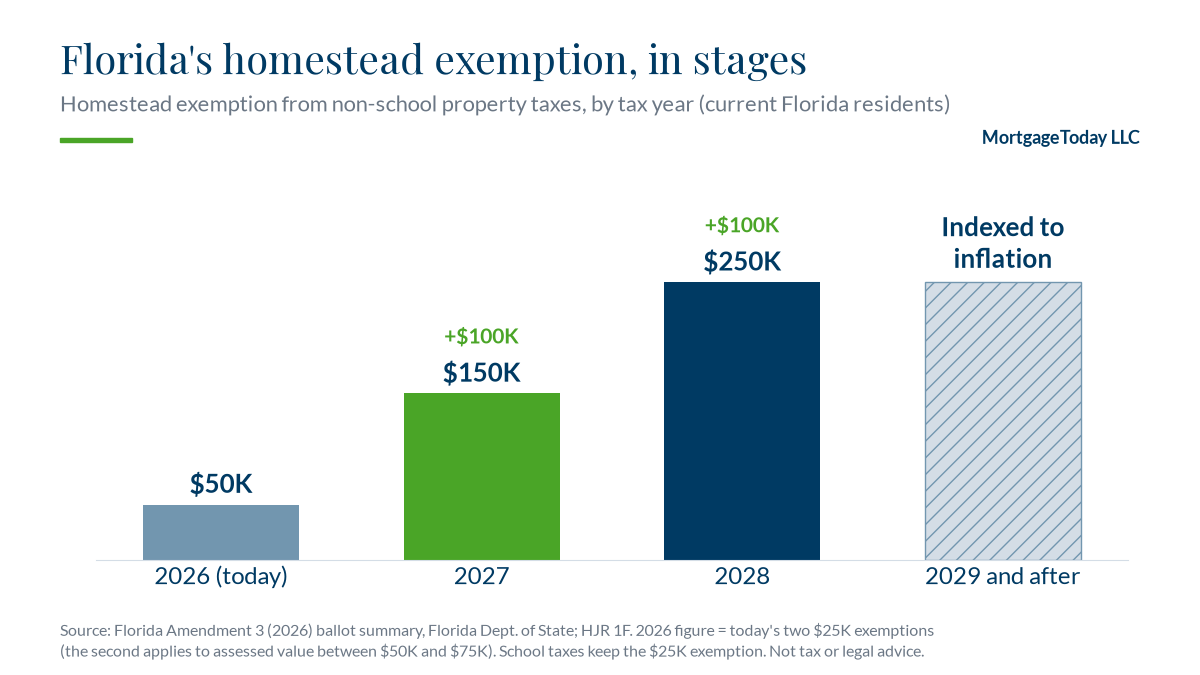
Tax year | Non-school homestead exemption | What to watch |
|---|---|---|
2026 (today) | About $50K | Nothing changes on this year's bill, due by March 31, 2027 |
2027 | $150K | First bill with the bigger exemption arrives around November 2027 |
2028 | $250K | Full step-up; escrow analyses start to reflect it |
2029 and after | $250K, adjusted for inflation | Watch your county's millage and any new fees |
New residents (not FL residents on Dec 31, 2026) | Existing exemption first, bigger one from the 5th year of exemption | Someone who homesteads in 2028 would see the bigger exemption around 2032 |
For homeowners: what it looks like in a payment
Simple example. Say your home is assessed at $500K and your non-school millage is around 12 mills (that's $12 for every $1,000 of taxable value).
An extra $200K of exemption by 2028 works out to roughly $2,400 a year. That's about $200 a month off your escrow.
Here's the same math at three assessed values. These are illustrative estimates, assuming 12 non-school mills, no other exemptions, and millage that stays the same:
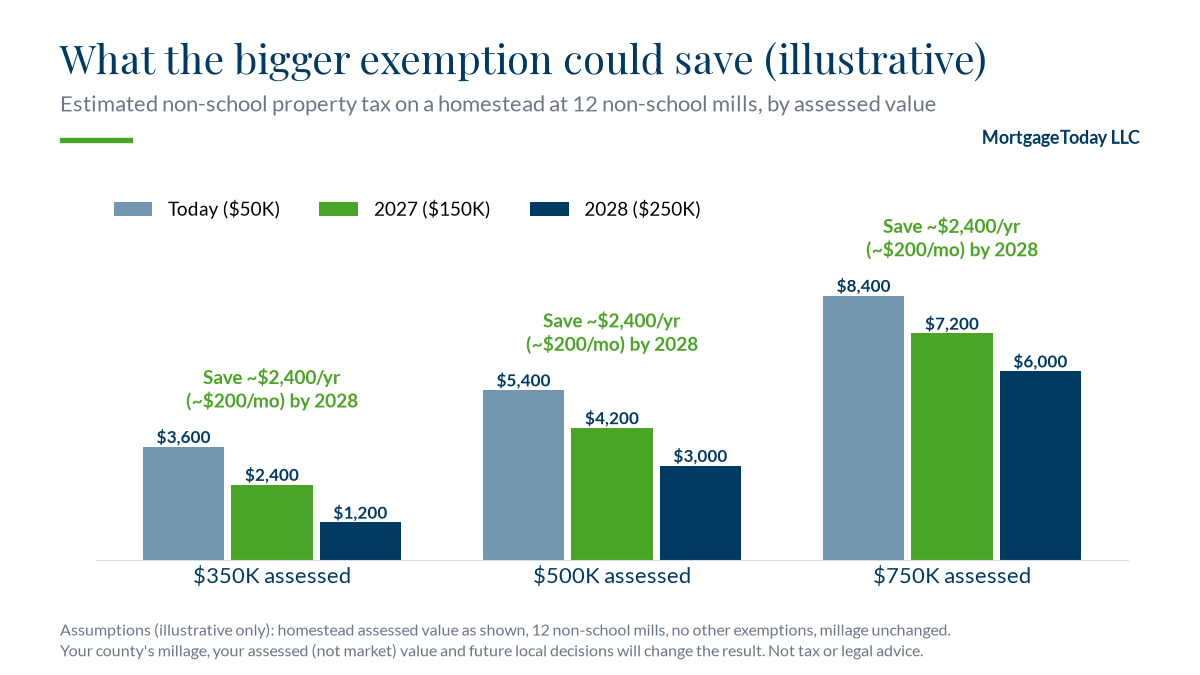
Assessed value | Non-school tax today ($50K exemption) | 2027 ($150K) | 2028 ($250K) | Estimated savings by 2028 |
|---|---|---|---|---|
$350K | $3,600 | $2,400 | $1,200 | ~$2,400/yr (~$200/mo) |
$500K | $5,400 | $4,200 | $3,000 | ~$2,400/yr (~$200/mo) |
$750K | $8,400 | $7,200 | $6,000 | ~$2,400/yr (~$200/mo) |
Notice something? Once your assessed value is above $250K, the extra $200K of exemption saves roughly the same dollars at the same millage. In percentage terms, the biggest relief goes to homes with lower assessed values. At $350K, the non-school bill in this example drops by two-thirds.
Two important details:
Assessed value isn't market value. If you've had your homestead for years, Save Our Homes has probably kept your assessed value well below what the house would sell for. Your exemption comes off the assessed value, so check your number on your county property appraiser's site.
Your county's millage will move the number up or down. Miami-Dade, Broward, Hillsborough and Orange all have different rates, and cities and special districts stack on top. Use your own TRIM notice, not my 12-mill example.
But for a lot of Florida homeowners, this is the first time in years the escrow line on their statement might actually go down instead of up.
How your escrow actually catches up
If your taxes are paid through an escrow account, the savings don't show up overnight. Here's how it usually works:
August: your county mails the TRIM notice (Truth in Millage) with your proposed taxes for the year. That's your first real look at the new number.
November: the tax bill comes out, and your servicer pays it from your escrow account (often early, to get the November discount).
Escrow analysis: at least once a year, your servicer runs an escrow analysis. It projects the next 12 months of taxes and insurance and compares that with what's in the account.
Surplus or shortage: if taxes dropped and the account collected more than it needed, that's a surplus. Federal rules generally require servicers to refund a surplus of $50 or more within 30 days of the analysis. Smaller amounts may be credited to next year. If insurance went up more than taxes went down, you can still end up with a shortage, usually spread over the next 12 months.
New monthly escrow: the analysis resets the monthly escrow amount for the next year.
So for the 2027 tax year, most homeowners with escrow won't see a lower monthly escrow until the analysis that follows the November 2027 bill, and the full $250K step shows up after the 2028 bill. The change comes over time, not overnight.
A few things to keep in mind:
Insurance is still the wild card in Florida. Lower taxes help, but they don't fix a big insurance bill. If your premium jumps at renewal, it can eat part or all of the tax savings in the same escrow analysis.
Make sure your homestead is actually filed. You'd be surprised how many people never did it. No homestead, no exemption, big or small.
Read your escrow statement when it comes. If your bill went down and your escrow didn't, ask your servicer when the next analysis is scheduled.
Your homestead filing checklist

If you own and live in your Florida home as your permanent residence, this is the most valuable 20 minutes you'll spend this year:
☐ Own the home and make it your permanent residence by January 1 of the tax year you're filing for.
☐ File with your county property appraiser by March 1. Most counties take applications online. Miss March 1 and you may lose the exemption for that year.
☐ Have your documents ready. Typically: Florida driver's license or ID with the property address, Florida vehicle registration, voter registration (if you vote), and Social Security numbers for you and your spouse. Non-citizens usually need proof of permanent residency.
☐ Already filed? Look up your parcel on the property appraiser's website and confirm the homestead exemption shows up. In most counties it renews automatically each year.
☐ Moved within Florida? Ask about portability: you may be able to transfer part of your Save Our Homes benefit to your new home. You have to apply for it.
☐ Bought this year? The seller's exemption doesn't carry over to you. You have to file your own.
☐ Renting out part of the home or moving out? Ask the property appraiser before you do. Renting can affect your homestead status.
For investors: no exemption, but more predictability

Rentals and investment properties don't get the homestead exemption. That part didn't change.
What did change is the assessment cap. Going from 10% to 5% means fewer surprise jumps in your tax bill year over year. If you're running DSCR numbers on a Florida rental, that makes the long-term math easier to plan around.
Here's an illustrative example. Take a rental with a $400K non-school assessed value in 2026, in a market where values rise at least as fast as the cap, so the assessment hits the maximum every year:
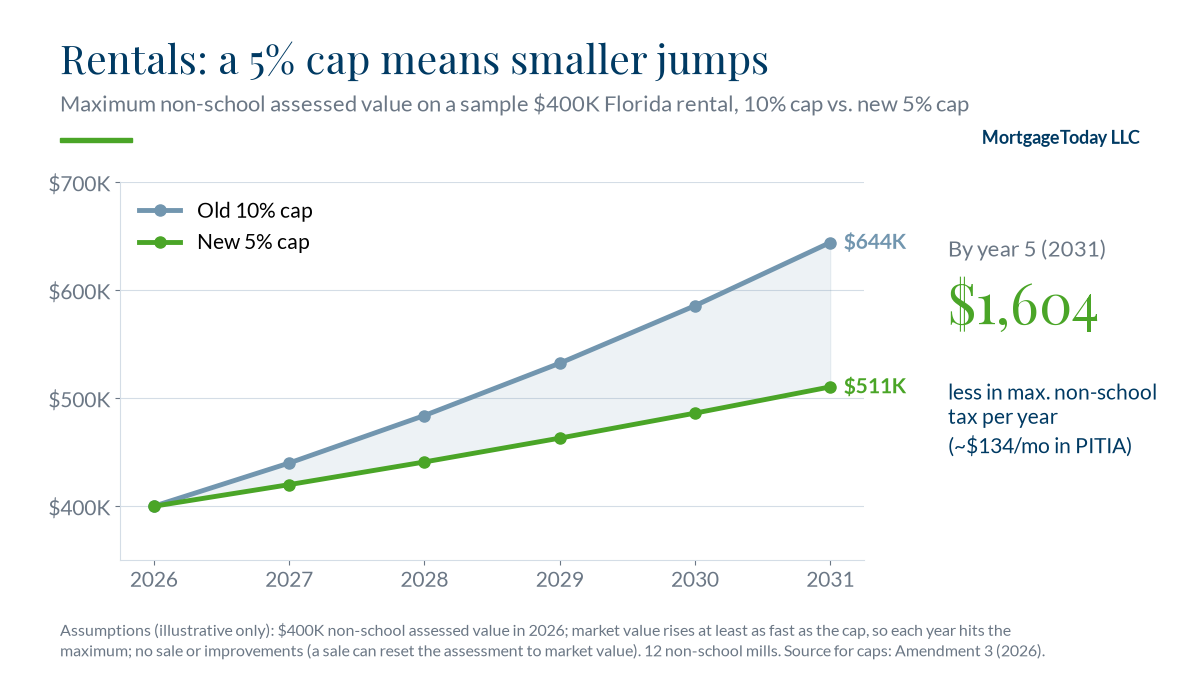
Year | Max assessed value, old 10% cap | Max assessed value, new 5% cap |
|---|---|---|
2026 | $400,000 | $400,000 |
2027 | $440,000 | $420,000 |
2028 | $484,000 | $441,000 |
2029 | $532,400 | $463,050 |
2030 | $585,640 | $486,203 |
2031 | $644,204 | $510,513 |
At 12 non-school mills, that's about $7,730 vs. $6,126 of maximum non-school tax by year 5: roughly $1,604 a year, or about $134 a month less in the taxes line of your PITIA. On a DSCR loan, where the ratio is rent divided by the full housing payment, a lower tax line is a better ratio.
A few honest caveats:
The cap is a ceiling, not a forecast. If values rise slower than 5%, the cap doesn't bind and nothing changes. If values fall, assessments can follow them down.
Buying resets things. A sale or change of ownership can bring the assessment back to market value at the next assessment date, and then the cap starts from there. Don't underwrite a purchase off the seller's tax bill.
School taxes aren't capped this way, so part of your bill still follows market value.
The open question: local governments are projected to lose billions in revenue. State economists estimated about $4.9 billion in the first fiscal year (2027–28), growing to roughly $11.8 billion a year by 2031–32. Some of that may get made up through millage changes, fees, or special assessments, and more of the load may land on non-homestead property. I'd watch your county closely over the next 12 to 24 months before assuming your tax line drops.
My take for investors: underwrite conservatively, keep tax assumptions realistic, and don't buy a deal that only works if taxes fall. Rental income and returns are never guaranteed.
Will home values go up?
Maybe some support at the margin. Lower carrying costs make owning more affordable, and affordability supports demand.
But I wouldn't call this a price catalyst by itself. Florida payments are driven by insurance, HOA fees, rates, and inventory just as much as taxes. In a lot of condo buildings, the HOA and special assessments are a bigger issue than the tax bill.
So: helpful for buyers, not a magic switch for prices.
Will it bring more people to Florida?
Long term, it probably helps the story. Florida already sells itself on no state income tax. Adding meaningful homestead relief makes the pitch stronger.
Short term, less than people think. The 5-year wait means someone moving here in 2027 doesn't see the full benefit until around 2032. The people who win first are current homesteaded owners and people who were already Florida residents on December 31, 2026.
That timing is where agents can add real value.
Realtors: this is your conversation starter for the next 60 days
Ask every relocating buyer one question: "When did (or when will) Florida become your permanent residence?" Timing matters now. Have them confirm the details with a tax professional or the property appraiser, but you being the one who raised it builds trust fast.
Add the new homestead math to your listing presentations. Show sellers what a buyer's estimated property taxes could look like in 2028 versus today. Lower projected carrying costs can help support the price conversation.
Talk to your current buyers who are on the fence. If taxes were part of what scared them off, the numbers just changed. It's worth a second look.
Remind every buyer who closes to file homestead by March 1. It's the easiest win you can hand a client, and they'll remember who told them.
Be the agent who explains it clearly. Most people will only hear the headline. The agent who walks them through what it actually means for their budget is the one they remember.
If you want a co-branded one-pager with the homestead math for your buyers, send me a message and we'll put one together.
Bottom line
This is good news for Florida homeowners. It's a real reduction, it's coming in stages, and it rewards people who own and live in their homes here.
For investors, it's more about predictability than savings.
And for agents, it's one of the best reasons in a while to call your database.
If you want me to run the numbers on a specific property, send me a message. As a broker, we compare 40+ lenders to find the loan that fits your plan, whether that's a primary home, a second home, or a DSCR rental. Happy to help.
Y si prefieres hablar en español, aquí estamos: hablamos español.
Thank you, Kevin
Sources: Florida Division of Elections, Nov. 3, 2026 General Election results, Amendment 3 (unofficial) · Florida Dept. of State, Amendment 3 ballot title, summary and full text · Florida Dept. of State, Amendment 3 ballot language (PDF) · Florida Revenue Estimating Conference, Amendment 3 impact estimate (PDF) · Tax Foundation, Florida Amendment 3 · Consumer Financial Protection Bureau, escrow accounts (Regulation X, 12 CFR 1024.17) · Florida Dept. of Revenue, homestead exemption and portability. Vote share is the unofficial count as of early Nov. 4, 2026.
Kevin Rodriguez, NMLS #1959152 · MortgageToday LLC, NMLS #2727066 · Equal Housing Opportunity